NPL ratio Bangladesh 2026, Is my bank safe 2026, Bangladesh bank mergers list, Shommilito Islami Bank merger, Defaulted loans recovery.
The NPL Crisis in Bangladesh (2026): Is Your Money Safe After the Bank Mergers?
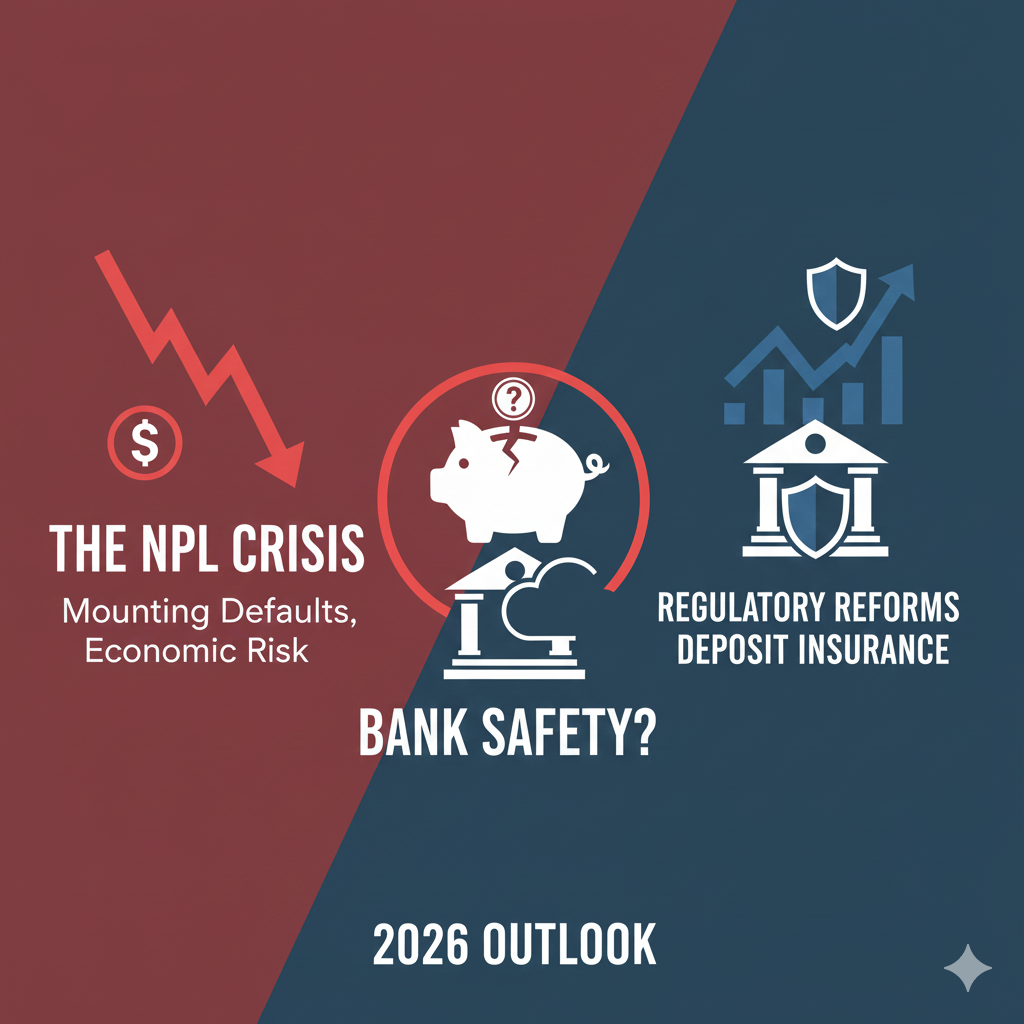
The Bangladesh banking sector entered 2026 facing a historic challenge: a Non-Performing Loan (NPL) ratio that peaked at nearly 36% in late 2025. With the recent formation of Shommilito Islami Bank PLC through a massive merger, many depositors are asking: Is my bank the next to be merged?
1. The 2025-26 Merger Wave: What Happened?
In a move to save the Islamic banking wing, Bangladesh Bank issued the “Bank Resolution Scheme 2025.” This led to the merger of five struggling banks (Exim, First Security, Global Islami, Social Islami, and Union Bank) into one entity.
- Depositor Protection: Under the new ordinance, deposits up to 2 Lakh BDT are immediately secured by the Insurance Trust Fund.
- Account Validity: If your bank was merged, your old checkbooks and deposit slips remain legally valid for the transition period.
2. Why NPLs are at an All-Time High
The surge to Tk 6.44 lakh crore in defaulted loans is attributed to:
- Stricter Classification: Bangladesh Bank now classifies a loan as “bad” if it is overdue for only 3 months (previously 6 months), aligning with IMF standards.
- Legacy Defaults: Unveiling “hidden” bad loans that were previously rescheduled multiple times.
3. The Recovery Roadmap: Can the Sector Bounce Back?
The central bank has set a target to bring NPLs down to 8% by June 2026. Key strategies include:
- ADR (Alternative Dispute Resolution): Banks are now mandated to recover at least 1% of NPLs through out-of-court settlements.
- Write-off Reforms: The time limit for writing off bad loans has been reduced from 3 years to 2 years to clean up balance sheets faster.
- Asset Management Companies (BAMCO): The introduction of a dedicated “Bad Bank” to buy distressed assets from commercial banks.
4. How to Check Your Bank’s Health
Before opening a new account in 2026, check these three indicators (usually found in the bank’s “Investor Relations” page):
- CAR (Capital Adequacy Ratio): Should ideally be above 12.5%.
- Provision Shortfall: A high shortfall indicates the bank hasn’t set aside enough money for bad loans.
- Liquidity Coverage Ratio (LCR): Ensures the bank can handle a sudden “bank run.”
Final Verdict for 2026
The banking sector is in a “cleaning phase.” While NPLs are high, the central bank’s aggressive “Bank Resolution” approach means that a total collapse is unlikely. However, for maximum safety, it is wise to diversify your savings across multiple A-grade private banks and government savings tools.
Navigating the 2026 Bangladesh Banking Crisis: Mergers, NPLs, and Deposit Security
The Bangladesh banking landscape has changed forever. On January 1, 2026, the official signboards of five major Islamic banks were replaced by a single name: Sammilito Islami Bank PLC. This is the first major action under the Bank Resolution Ordinance 2025, a law designed to prevent a total systemic collapse.
1. The Sammilito Islami Bank Merger: What You Need to Know
To save the Shariah-based banking sector, the central bank merged EXIM, First Security, Global Islami, Social Islami, and Union Bank.
- Status of Deposits: If your balance is under 2 Lakh BDT, you have full access to your funds as of January 2, 2026.
- Large Withdrawals: For balances above 2 Lakh, withdrawals are currently capped at 1 Lakh BDT per quarter to manage liquidity.
- Checkbooks: Your old checkbooks remain legally valid during the transition period.
2. Why the Crisis Happened: The 35.7% NPL Shock
In late 2025, non-performing loans (NPLs) hit a record Tk 6.44 lakh crore. This “systemic shock” was caused by:
- Stricter Rules: Bangladesh Bank now classifies loans as “bad” after only 90 days of non-payment.
- Governance Failures: The “S. Alam” era legacy of insider lending has finally been accounted for on official balance sheets.
3. The Bank Resolution Ordinance 2025: A New Era of Safety
The new ordinance gives the Bank Resolution Department (BRD) unprecedented powers. They can now:
- Appoint independent administrators to any “distressed” bank.
- Force mergers without shareholder consent if a bank’s capital falls below the required threshold.
- Convert a portion of institutional deposits into bank shares (equity) to stabilize the balance sheet.
4. FAQ: Frequently Asked Questions (Position Zero Snippet)
Q: Is Sammilito Islami Bank a government bank? A: No, it is a private bank, but the government has provided significant liquidity support and oversight through Bangladesh Bank to ensure depositor safety.
Q: What happens if my bank is on the “Weak Banks” list? A: Under the 2025 regulations, “Weak Banks” are under Risk-Based Supervision (RBS). This means the central bank is monitoring every transaction to ensure no money is laundered or illegally withdrawn. Your money is generally safer now than it was two years ago due to this oversight.
Final Verdict for Investors
The banking sector is currently in its “Great Cleaning.” While news of 35% bad loans may seem scary, the Bank Resolution Ordinance ensures that individual depositors (up to 2 Lakh BDT) are the first priority for protection. For larger amounts, diversification across A-grade private banks and Sanchayapatra remains the smartest move.