Focus Keywords: Fixed Deposit rates Bangladesh 2026, Sanchayapatra interest rate 2026, Best savings scheme Bangladesh, FDR vs Sanchayapatra comparison.
Fixed Deposit vs. Sanchayapatra in Bangladesh (2026): Which is Best for Your Savings?
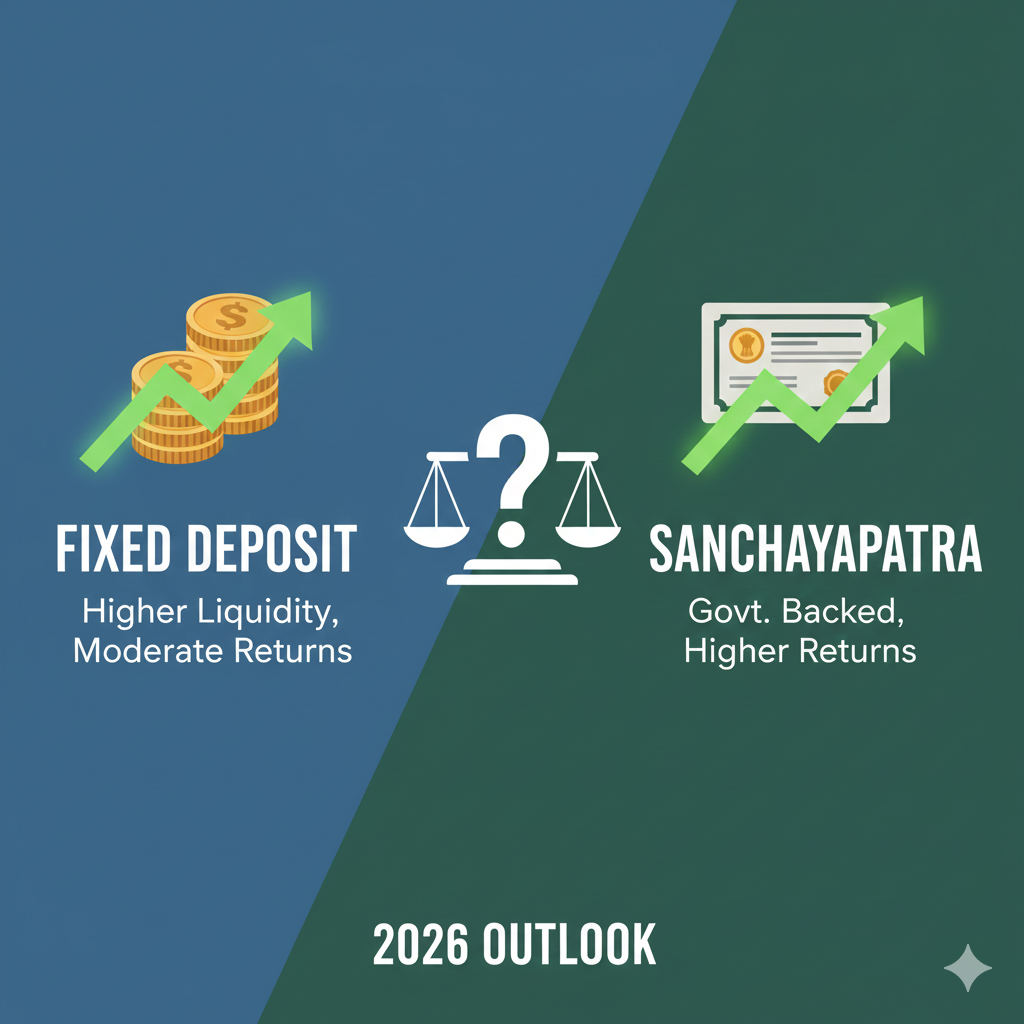
In the current high-inflation economy of 2026, keeping your money in a standard savings account is a losing game. With inflation hovering around 8.29%, savers are searching for the best way to protect their purchasing power. Should you lock your money in a Bank Fixed Deposit (FDR) or go for the Government’s Sanchayapatra (Savings Certificates)?
1. Current Interest Rate Landscape (January 2026)
As of early 2026, the Bangladesh Bank’s contractionary monetary policy has pushed bank deposit rates to decade-highs.
- Fixed Deposits (FDR): Most private commercial banks (PCBs) are offering between 9.50% and 11.50% for 1-year tenures. Some “B-grade” banks are even offering up to 12.00% to attract liquidity.
- Sanchayapatra: The 5-year Bangladesh Sanchayapatra still offers a competitive edge with rates around 11.28% (before tax), but strict investment ceilings remain.
2. Comparison Table: At a Glance
| Feature | Fixed Deposit (FDR) | Sanchayapatra (Savings Cert.) |
| Max Interest | Up to 12.00% (varies by bank) | ~11.28% (Fixed by Govt) |
| Investment Limit | No upper limit | Max 30 Lac (Single) / 60 Lac (Joint) |
| Tax on Profit | 10% (for TIN holders) | 5% (up to 5 Lac) / 10% (above 5 Lac) |
| Liquidity | Easy to break (with penalty) | Harder to encash before 1 year |
| Security | Bank-dependent (Varies) | Highest (Sovereign Guarantee) |
3. The “Real Return” Calculation
To understand if you are actually making money, you must subtract inflation from your interest rate.
If your bank gives you 10.5% and inflation is 8.3%, your real profit is:
$$10.5\% – 8.3\% = 2.2\% \text{ (before tax)}$$
4. Who Should Choose What?
- Choose Sanchayapatra if: You are a retiree, a woman (eligible for Family Savings Certificates), or looking for the absolute highest security for a long-term (5-year) period.
- Choose Fixed Deposit (FDR) if: You have more than 60 Lac BDT to invest, or you might need the money in 3 to 12 months.
Article 2: The NPL Crisis & Bank Safety 2026
Focus Keywords: NPL ratio Bangladesh 2026, Is my bank safe 2026, Bangladesh bank mergers list, Shommilito Islami Bank merger, Defaulted loans recovery.
The NPL Crisis in Bangladesh (2026): Is Your Money Safe After the Bank Mergers?
The Bangladesh banking sector entered 2026 facing a historic challenge: a Non-Performing Loan (NPL) ratio that peaked at nearly 36% in late 2025. With the recent formation of Shommilito Islami Bank PLC through a massive merger, many depositors are asking: Is my bank the next to be merged?
1. The 2025-26 Merger Wave: What Happened?
In a move to save the Islamic banking wing, Bangladesh Bank issued the “Bank Resolution Scheme 2025.” This led to the merger of five struggling banks (Exim, First Security, Global Islami, Social Islami, and Union Bank) into one entity.
- Depositor Protection: Under the new ordinance, deposits up to 2 Lakh BDT are immediately secured by the Insurance Trust Fund.
- Account Validity: If your bank was merged, your old checkbooks and deposit slips remain legally valid for the transition period.
2. Why NPLs are at an All-Time High
The surge to Tk 6.44 lakh crore in defaulted loans is attributed to:
- Stricter Classification: Bangladesh Bank now classifies a loan as “bad” if it is overdue for only 3 months (previously 6 months), aligning with IMF standards.
- Legacy Defaults: Unveiling “hidden” bad loans that were previously rescheduled multiple times.
3. The Recovery Roadmap: Can the Sector Bounce Back?
The central bank has set a target to bring NPLs down to 8% by June 2026. Key strategies include:
- ADR (Alternative Dispute Resolution): Banks are now mandated to recover at least 1% of NPLs through out-of-court settlements.
- Write-off Reforms: The time limit for writing off bad loans has been reduced from 3 years to 2 years to clean up balance sheets faster.
- Asset Management Companies (BAMCO): The introduction of a dedicated “Bad Bank” to buy distressed assets from commercial banks.
4. How to Check Your Bank’s Health
Before opening a new account in 2026, check these three indicators (usually found in the bank’s “Investor Relations” page):
- CAR (Capital Adequacy Ratio): Should ideally be above 12.5%.
- Provision Shortfall: A high shortfall indicates the bank hasn’t set aside enough money for bad loans.
- Liquidity Coverage Ratio (LCR): Ensures the bank can handle a sudden “bank run.”
Final Verdict for 2026
The banking sector is in a “cleaning phase.” While NPLs are high, the central bank’s aggressive “Bank Resolution” approach means that a total collapse is unlikely. However, for maximum safety, it is wise to diversify your savings across multiple A-grade private banks and government savings tools.