Quick Answer
To calculate income tax in Bangladesh, subtract your tax-free threshold (BDT 375,000 for general taxpayers in FY 2025–26) from your total annual income to get your taxable income. Then apply the progressive NBR tax slabs (10%, 15%, 20%, 25%, 30%) to each portion of that income, subtract any eligible investment rebate, and compare the result against the BDT 5,000 minimum tax — whichever is higher is what you owe.
Table of Contents
- What Is Income Tax in Bangladesh?
- Income Tax Slabs & Tax-Free Limits (FY 2025–26)
- Step-by-Step: How to Calculate Income Tax in Bangladesh
- Worked Example
- Investment Tax Rebate Explained
- Minimum Tax Rule
- Who Needs to File Income Tax in Bangladesh?
- Common Mistakes to Avoid
- Frequently Asked Questions
What Is Income Tax in Bangladesh?
Income tax is a direct tax charged on the earnings of individuals, companies, and other entities under the Income Tax Ordinance/Act, administered by the National Board of Revenue (NBR). Bangladesh follows a progressive tax system — the more you earn, the higher the rate on each additional slab of income.
- Applies to salaried individuals, freelancers, business owners, and companies
- Rates and tax-free limits are updated almost every fiscal year through the Finance Ordinance
- Filing is done through the NBR e-Return portal
Income Tax Slabs & Tax-Free Limits (FY 2025–26)
Tax-free limits by taxpayer category:
| Taxpayer Category | Tax-Free Limit (BDT) |
|---|---|
| General taxpayer | 375,000 |
| Woman / Senior citizen (65+) | 425,000 |
| Person with disability / Third gender | 500,000 |
| Gazetted war-wounded freedom fighter | 525,000 |
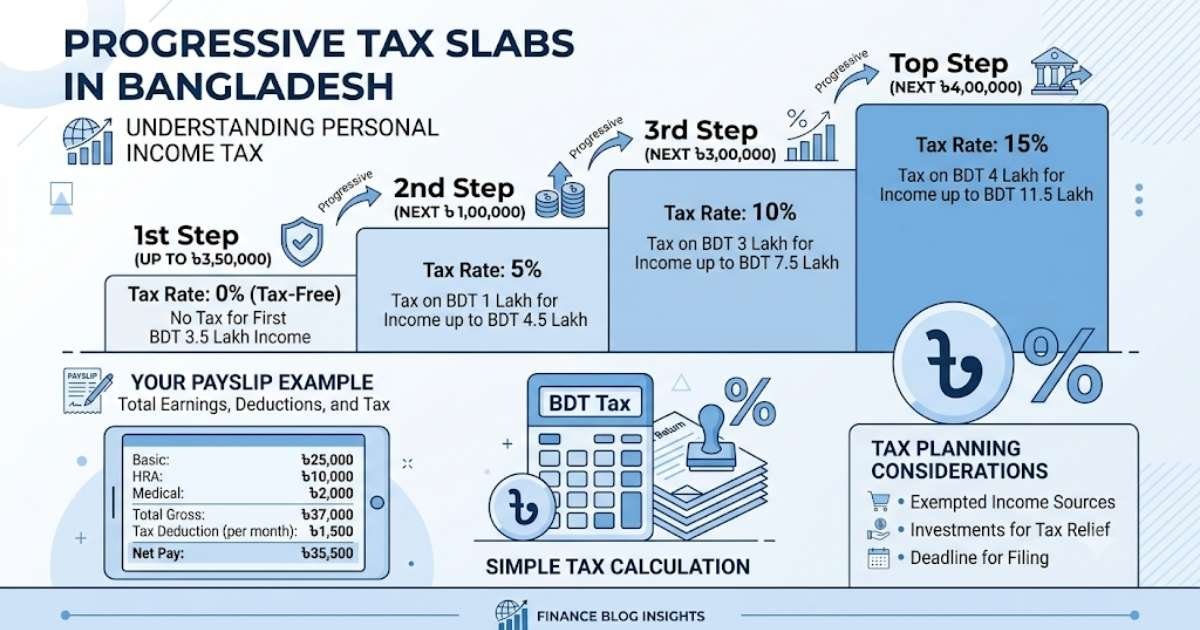
Progressive tax slabs (income above the tax-free limit):
| Income Slab | Tax Rate |
|---|---|
| Next BDT 300,000 | 10% |
| Next BDT 400,000 | 15% |
| Next BDT 500,000 | 20% |
| Next BDT 2,000,000 | 25% |
| Remaining income | 30% |
Note: The Finance Ordinance 2025 removed the earlier 5% starter slab, so the first taxable portion now starts at 10%. Rates and thresholds change yearly — always confirm the current figures on the official NBR site before filing.
Step-by-Step: How to Calculate Income Tax in Bangladesh
- Step 1: Add up your total annual income — salary, business income, rental income, capital gains, and other sources
- Step 2: Identify your taxpayer category — general, woman/senior citizen, person with disability, or freedom fighter
- Step 3: Subtract your applicable tax-free limit from total income to get taxable income
- Step 4: Apply the progressive slab rates to each portion of taxable income (not the whole amount at one flat rate)
- Step 5: Add up the tax from each slab to get your gross tax liability
- Step 6: Calculate your investment rebate (if eligible) and subtract it from the gross tax
- Step 7: Compare the result with the minimum tax (BDT 5,000) — you pay whichever is higher, if your income exceeds the tax-free limit
- Step 8: File your return through the NBR e-Return portal and pay any balance due by the deadline
Worked Example
Scenario: A general (male, non-senior) taxpayer with an annual income of BDT 1,200,000.
Step 1: Total Income = BDT 1,200,000
Step 2: Tax-Free Limit = BDT 375,000
Step 3: Taxable Income = 1,200,000 − 375,000 = BDT 825,000

Step 4: Apply slabs to taxable income
  First BDT 300,000 × 10% = BDT 30,000
  Next BDT 400,000 × 15%  = BDT 60,000
  Remaining BDT 125,000 × 20% = BDT 25,000

Step 5: Gross Tax = 30,000 + 60,000 + 25,000 = BDT 115,000
If this person invested BDT 200,000 in approved savings instruments (e.g., Sanchayapatra, DPS, stocks), the rebate calculation would apply next (see below) and reduce the final payable amount.
Investment Tax Rebate Explained
Bangladesh allows a tax rebate for investing in NBR-approved instruments such as Sanchayapatra (savings certificates), DPS, listed stocks, and mutual funds.
The rebate is the lowest of these three amounts:
- 15% of the actual eligible investment
- 3% of total taxable income
- BDT 10,00,000 (maximum rebate ceiling)
Example: If eligible investment = BDT 200,000 and taxable income = BDT 825,000:
15% of investment = 30,000
3% of taxable income = 24,750
Lowest value = BDT 24,750 → this is the rebate applied
Final Payable Tax = Gross Tax − Rebate = 115,000 − 24,750 = BDT 90,250
Minimum Tax Rule
- A flat minimum tax of BDT 5,000 applies to individual taxpayers whose income exceeds the tax-free limit, regardless of location (Finance Ordinance 2025 standardized this across all areas)
- Even if your slab-based calculation results in a lower figure after rebate, you must still pay at least the minimum tax
- This replaced the earlier location-based minimum tax structure (which varied between BDT 3,000–5,000 depending on city corporation area)
Who Needs to File Income Tax in Bangladesh?
- Anyone whose annual income exceeds the applicable tax-free limit
- Anyone required to hold a TIN (Tax Identification Number) — mandatory once annual income crosses BDT 375,000, and also required for opening certain bank accounts, buying savings certificates, or obtaining a trade license
- Government employees, company directors, and specific professional categories, regardless of income level
- The general return filing deadline for individuals is typically 30 November following the end of the income year
Common Mistakes to Avoid
- Applying one flat tax rate to your entire income instead of the correct slab-by-slab calculation
- Forgetting to use the correct tax-free limit for your specific category (general vs. woman/senior vs. disability vs. freedom fighter)
- Missing the investment rebate entirely, or miscalculating it by ignoring the “lowest of three” rule
- Assuming the minimum tax doesn’t apply just because the slab calculation results in a lower number
- Using last year’s slabs — rates and thresholds are revised almost every Finance Ordinance
Frequently Asked Questions
What is the tax-free income limit in Bangladesh for FY 2025–26? BDT 375,000 for general taxpayers, BDT 425,000 for women and senior citizens (65+), BDT 500,000 for persons with disabilities and third-gender taxpayers, and BDT 525,000 for gazetted freedom fighters.
How is income tax calculated in Bangladesh? Subtract the applicable tax-free limit from total income to get taxable income, then apply the progressive slab rates (10%, 15%, 20%, 25%, 30%) to each portion, subtract any eligible investment rebate, and pay whichever is higher between that result and the BDT 5,000 minimum tax.
What is the minimum tax in Bangladesh? A flat BDT 5,000 applies to individual taxpayers whose income exceeds the tax-free limit, regardless of where they live.
How much rebate can I get for investments? The rebate is the lowest of: 15% of your actual eligible investment, 3% of your total taxable income, or a BDT 10,00,000 ceiling.
Who must obtain a TIN in Bangladesh? Anyone whose annual income exceeds BDT 375,000, along with anyone needing one for banking, savings certificates, trade licenses, or specific government/professional requirements.
When is the income tax return deadline in Bangladesh? Generally 30 November following the end of the income year, though NBR may issue extensions.
On-Page SEO Checklist (For Publishing)
- Title tag: Under 60 characters, exact-match keyword near the front
- Meta description: Under 155 characters, includes “step by step” + fiscal year
- URL: Short, hyphenated, keyword-matching slug
- H1: Matches the target keyword closely (used once only)
- Featured snippet box: A direct-answer block right after the H1 — critical for AEO since AI Overviews and voice assistants extract from short, self-contained answers
- FAQ schema: Mark up the FAQ section with
FAQPageJSON-LD for rich snippet eligibility - HowTo schema: Apply to the step-by-step section so Google can render it as a numbered rich result
- Internal links: Link to a VAT calculator article, a TIN registration guide, and the official NBR e-Return portal
- Concrete numbers: Use real BDT figures in every example — AI answer engines strongly prefer citable, specific numbers over vague ranges
- Freshness signal: Mention “FY 2025–26” explicitly and add a “last updated” date, since slabs change yearly
- E-E-A-T signal: Cite NBR as the authoritative source; consider an author byline with tax/accounting credentials